
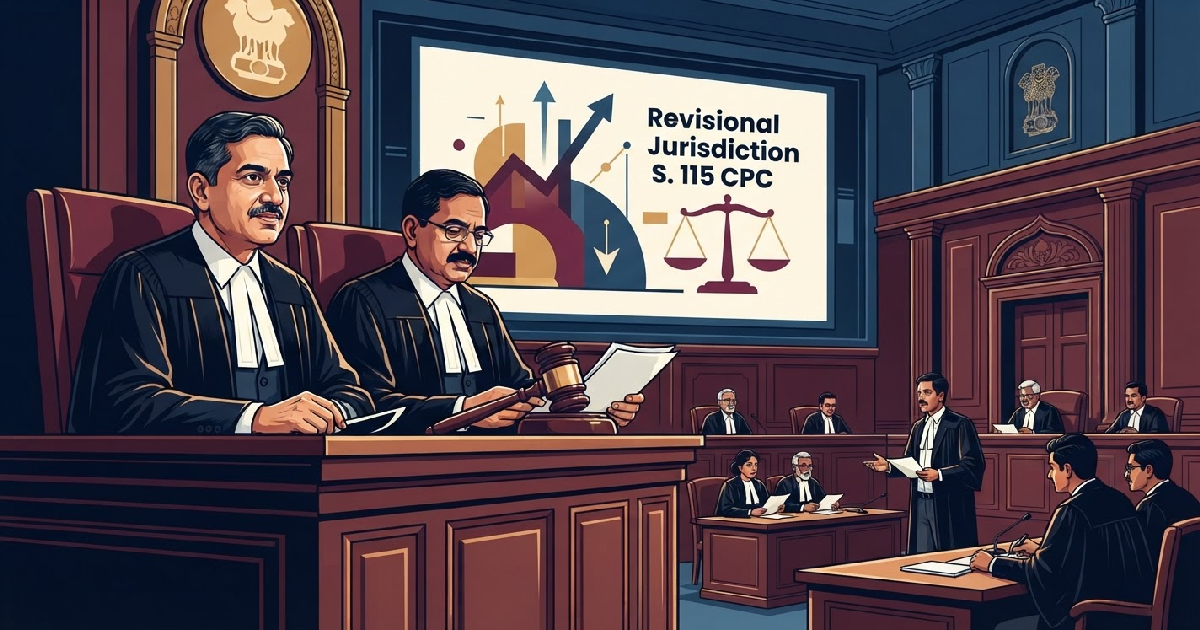
In a landmark decision handed down on Tuesday, July 21, 2026, the Supreme Court of India clarified the stringent boundaries of revisional jurisdiction under Section 115 of the Code of Civil Procedure (CPC).
A bench comprising Justice Sanjay Karol and Justice Augustine George Masih explicitly ruled that this power cannot be used to rectify mere errors of fact or law unless they pertain to a jurisdictional error.
The Supreme Court’s decisive ruling on revisional powers
This pivotal judgment, delivered in the case of MADAN MOHAN (DEAD) THROUGH LRS. VERSUS THAKAR DASS (DEAD) THR. LRS., directly set aside a ruling from the Punjab and Haryana High Court. The High Court had overstepped its supervisory role by re-evaluating factual findings, even where alleged concealment of facts was involved.
The core of this Supreme Court pronouncement stems from a long-running landlord-tenant dispute. Both the Rent Controller and the Appellate Authority had previously decreed eviction orders, finding compelling evidence in favor of the landlord, Kamla Devi. They concluded that Ms. Devi genuinely required the shop for her son’s business and that the tenant had failed to tender arrears validly.
A crucial point of contention revolved around a third shop. The lower courts specifically found this shop was being used for storing garbage, rendering it unsuitable as alternative accommodation for the landlord’s bona fide requirement. Yet, the Punjab and Haryana High Court intervened, using its revisional powers under Section 115 CPC to reverse these concurrent findings.
Reaffirming jurisdictional limits in practice
The High Court’s intervention was primarily driven by its belief that the landlady had concealed the existence of this third shop. It concluded she had not “come to the Court with clean hands.” However, the Supreme Court took issue with this line of reasoning, pinpointing it as an overreach of revisional authority.
Justice Karol, delivering the judgment, posed a critical question: “If the shop that is alleged to be an alternate accommodation was being used for storing waste material as has been held by both the RA and the AA, then that being the finding of fact, what occasioned the High Court to take a different view in civil revisional jurisdiction?”
This query powerfully underscored the High Court’s error in re-evaluating facts already established by two lower tribunals. The Supreme Court made it clear that factual errors, even those concerning alleged concealment, cannot justify a revisional court substituting its own findings for those of the original tribunals.
Understanding Section 115 CPC’s core purpose
Section 115 of the Code of Civil Procedure, 1908, grants High Courts a limited power to supervise subordinate courts. This revisional power is designed to correct jurisdictional errors, ensuring that lower courts act within their legal mandates.
The term “revision” itself originates from the Latin word “revidere,” meaning “to see again,” which aptly describes its focus on legality and procedural propriety rather than a full re-examination of merits.
It’s crucial to distinguish revisional jurisdiction from appellate jurisdiction. An appeal allows a higher court to re-examine both facts and law, effectively conducting a fresh review of the case. Conversely, Section 115 CPC strictly limits intervention to instances where a subordinate court has:
- Exercised a jurisdiction not legally vested in it.
- Failed to exercise a jurisdiction that was legally vested.
- Acted illegally or with material irregularity in exercising its jurisdiction.
This distinction is fundamental to maintaining the integrity of the judicial hierarchy and ensuring efficient dispute resolution. The Supreme Court’s ruling reaffirms that these conditions are not a carte blanche for High Courts to re-open cases based on factual disagreements.
The 1999 amendment’s impact on revisional scope
The scope of revisional jurisdiction under Section 115 CPC underwent significant curtailment with the Code of Civil Procedure (Amendment) Act, 1999. This amendment, which came into force on July 1, 2002, aimed to streamline civil litigation and prevent undue delays. It specifically restricted the High Court’s ability to entertain revision petitions.
Post-amendment, revisions are generally maintainable only if the impugned order, if allowed to stand, would result in the final disposal of the suit or proceeding. This change was influenced by recommendations from the Malimath Committee, which sought to curb the common practice of challenging interlocutory orders through revisional powers, thereby delaying final judgments.
The Supreme Court has consistently interpreted this amendment to narrow the situations in which High Courts can intervene, focusing revisional efforts on errors that fundamentally impact the outcome.
| Jurisdiction Type | Governing Statute/Article | Scope of Review | Primary Focus |
|---|---|---|---|
| Revisional Jurisdiction | Section 115 CPC | Limited to jurisdictional errors, illegalities, material irregularities | Legality and propriety of subordinate court’s order; adherence to law |
| Appellate Jurisdiction | CPC (various sections for appeals) | Broad review of facts and law, re-appreciation of evidence | Correctness and soundness of lower court’s decision |
| Supervisory Jurisdiction | Article 227 of Constitution | Errors of jurisdiction, manifest injustice, perversity in findings | Ensuring lower courts and tribunals act within legal bounds |
A historical perspective on revisional jurisprudence
The Supreme Court’s recent judgment isn’t an isolated event; it builds upon a rich history of legal precedents defining the limits of revisional jurisdiction. Over decades, India’s apex court has consistently emphasized that Section 115 CPC is not a tool for High Courts to substitute their judgment on facts for that of lower courts.
This principle safeguards the finality of factual findings by tribunals best placed to assess evidence.
For example, in *Pandurang Ramchandra Mandlik v. Maruti Ramchandra Ghatge* (1996), the Supreme Court clearly stated that an erroneous decision on a point of law by a subordinate court, unrelated to its jurisdiction, cannot be corrected under Section 115 CPC. Similarly, *Welcome Hotel v.
State of A.P.* (1983) established that procedural irregularities due to a party’s mistake don’t warrant revisional interference if the court had jurisdiction.
When factual errors become jurisdictional questions
The challenge often lies in discerning when a factual error crosses the line into a jurisdictional one. The Supreme Court has repeatedly held that “mere errors of fact or law,” however significant, do not empower a revisional court to intervene unless they fundamentally alter the court’s jurisdiction to hear the case. This was articulated in cases like *Pandurang Dhondi Chougule v. Maruti Hari Jadhav* (1966).
Furthermore, in *Yunus Ali (Dead) Through His Legal Representatives v. Khursheed Akram* (2008), the Supreme Court stressed that High Courts cannot re-appreciate evidence or impose their own findings unless the lower court’s findings are perverse or demonstrate a complete non-appreciation of crucial evidence. The current ruling in *Madan Mohan* serves as a modern reaffirmation of these foundational principles, ensuring judicial discipline.
The Court has consistently maintained that the revisional power is supervisory, not appellate. This means it’s concerned with the legality and regularity of the proceedings, not the correctness of the conclusions on facts. A revisional court cannot re-evaluate evidence or disturb concurrent factual findings by lower courts, particularly when those findings are neither perverse nor tainted by any jurisdictional error.
Implications for High Courts and civil litigation
This Supreme Court directive has significant ramifications for both High Courts and the broader landscape of civil litigation across India. It acts as a clear reminder to High Courts to exercise restraint and adhere strictly to the confines of revisional jurisdiction. The ruling prevents High Courts from morphing into a “second appellate court” that re-examines factual matrixes already adjudicated by competent lower tribunals.
By reinforcing the limited scope of revisional jurisdiction S. 115 CPC, the Supreme Court aims to instill greater finality in legal proceedings. This can help reduce the backlog of cases by deterring litigants from seeking revisions merely to challenge factual outcomes. It also enhances the authority and credibility of Rent Controllers and Appellate Authorities, whose factual findings are now more securely insulated from casual interference.
Ensuring judicial restraint and procedural adherence
The distinction between revisional power and the supervisory jurisdiction granted under Article 227 of the Constitution is also pertinent here. While Article 227 allows High Courts to oversee tribunals, it is also exercised with caution and primarily when there is a manifest injustice or perversity in findings, not simply a disagreement over facts. This latest ruling promotes judicial restraint across various avenues of judicial review.
This ruling signals a renewed emphasis on procedural adherence and respect for the roles designated to different tiers of the judiciary. It discourages the practice of camouflaging factual disputes as jurisdictional errors, ensuring that resources are focused on genuine legal infirmities rather than subjective re-interpretations of evidence. The clarity provided by this judgment is invaluable for legal practitioners navigating the complexities of civil procedure.
What is the primary function of revisional jurisdiction under Section 115 CPC?
The primary function of revisional jurisdiction under Section 115 CPC is to ensure that subordinate courts act within their legal authority and jurisdiction. It allows High Courts to intervene only when a lower court has made jurisdictional errors, failed to exercise vested jurisdiction, or acted with material irregularity, not to correct mere factual or legal errors.
Why did the Supreme Court set aside the High Court’s judgment in this case?
The Supreme Court set aside the High Court’s judgment because the High Court had overstepped its revisional authority. It had re-evaluated and interfered with the concurrent factual findings of the Rent Controller and Appellate Authority, which had already established that an alleged third shop was used for garbage and thus not suitable alternative accommodation, despite claims of factual concealment.
How does this ruling impact civil litigation in India?
This ruling has significant implications for civil litigation by reinforcing judicial discipline and limiting the scope for High Courts to re-examine facts under revisional powers. It promotes finality in the factual findings of lower courts and aims to reduce delays caused by appeals disguised as revisions, thereby streamlining the judicial process.
In essence, the Supreme Court’s decision reinforces the foundational principle that revisional jurisdiction under Section 115 CPC is a supervisory power, not an appellate one.
It stands as a vital reminder that High Courts cannot assume the role of a fact-finding body to correct perceived factual inaccuracies, even if concealment is alleged, unless those inaccuracies amount to a clear jurisdictional error.
This move is expected to bring greater predictability and efficiency to civil proceedings by upholding the distinct roles of judicial forums.