
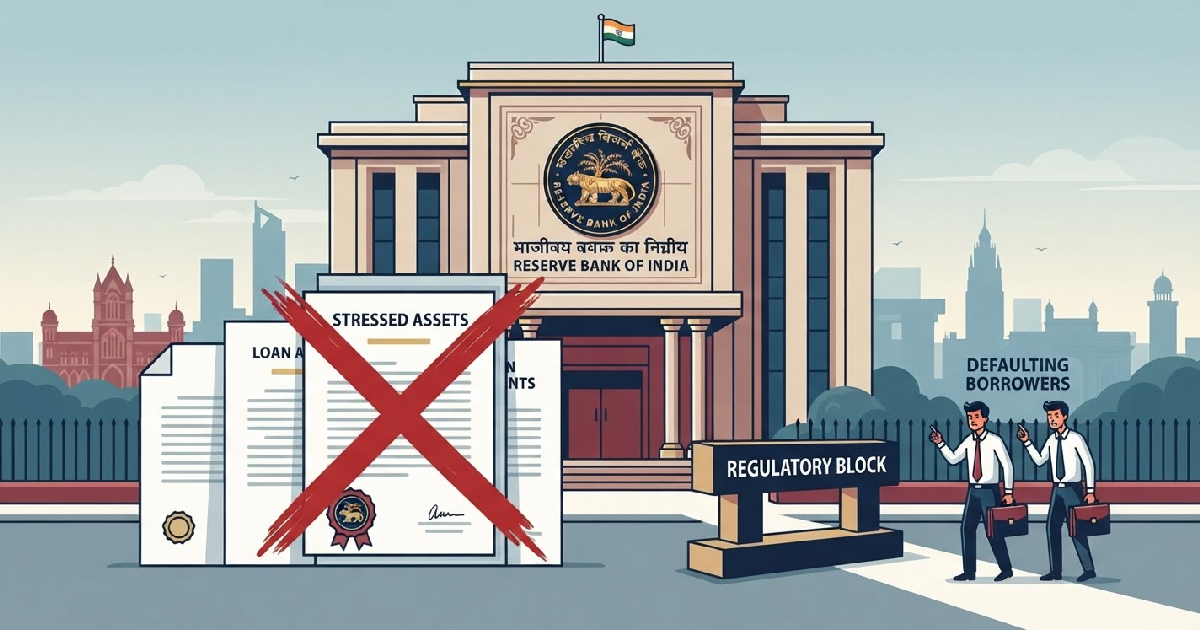
Effective October 1, 2026, new RBI stressed assets rules will prevent banks, SFBs, and NBFCs from selling acquired non-financial assets back to defaulting borrowers.
This significant move, announced on July 16, 2026, aims to enhance transparency and bolster credit discipline across India’s financial sector.
Blocking the path for reacquiring assets
Issued from its headquarters in Mumbai, the central bank’s directives prevent potential conflicts of interest and address concerns about “moral hazard” in asset resolution processes. The new regulations, formally part of the Third Amendment Directions, 2026, specifically target situations where lenders might inadvertently allow defaulting entities to regain control of assets through opaque mechanisms.
The core of the RBI’s new framework is a clear prohibition: once a lender acquires an SNFA, it cannot be sold back to the borrower who defaulted or to any of their related parties. This restriction applies even if the asset’s classification changes later on.
Related parties will be defined according to the Insolvency and Bankruptcy Code, 2016, ensuring a broad and consistent application of the rule.
SNFAs are primarily immovable assets that lenders acquire when trying to recover claims on a borrower whose loan has been categorized as a non-performing asset (NPA). For banks, this definition also covers non-banking assets (NBAs) obtained under the provisions of the Banking Regulation Act, 1949. This specificity ensures that the rules cover various types of assets lenders might seize.
The RBI has been explicit about its reasoning, stating that allowing defaulters to repurchase their assets could “create moral hazard and dilute credit discipline.” This strong stance highlights the regulator’s commitment to preventing practices that undermine the integrity of the lending ecosystem. It ensures that defaulting on loans carries appropriate consequences, rather than offering a potential loophole for regaining assets.
Mandates for transparent asset management
Under the new guidelines, banks, SFBs, and NBFCs must establish board-approved policies governing how they acquire, hold, and dispose of SNFAs. These policies aren’t just bureaucratic hurdles; they’re designed to instill robust governance. They need to detail internal limits on the aggregate value of SNFAs, set clear eligibility criteria, and outline the delegation of powers for managing these assets.
Furthermore, these policies must specify recovery efforts undertaken before an acquisition and set a maximum disposal period of seven years for SNFAs. The regulator expects lenders to dispose of assets much sooner if possible, ideally through public auctions consistent with the principles of the SARFAESI Act, 2002. This ensures a transparent and competitive process for asset sales.
Proper valuation is also a critical component. SNFAs must be recorded on the balance sheet at the lower of two figures: the net book value of the extinguished exposure or the distress sale value. This distress sale value isn’t arbitrary; it must be determined by at least two independent external valuers, adding another layer of scrutiny and fairness to the process.
New accounting standards and legacy assets
The RBI has also introduced distinct disclosure requirements for these assets. SNFAs will no longer be lumped in with calculations for gross non-performing assets (NPAs), net NPAs, stressed exposures, or provisioning coverage ratios. Instead, they will be disclosed under separate accounting heads on the balance sheets of banks, small finance banks, and NBFCs.
This change provides a clearer picture of a financial institution’s health, separating genuinely productive assets from those acquired through loan resolution. Lenders must also submit detailed annual reports on these assets through the RBI’s Central Information Management System (CIMS) portal. This new reporting standard will likely offer a more granular view of how lenders are managing their distressed portfolios.
For assets already on the books, the RBI has set a clear transition period. Any SNFAs outstanding as of September 30, 2026, must comply with these updated norms by September 30, 2027. This provides institutions with a year to align their existing asset management practices with the new regulatory framework.
Financial institutions will need to update their internal procedures to ensure all existing SNFAs meet the new compliance requirements by the specified deadline.